

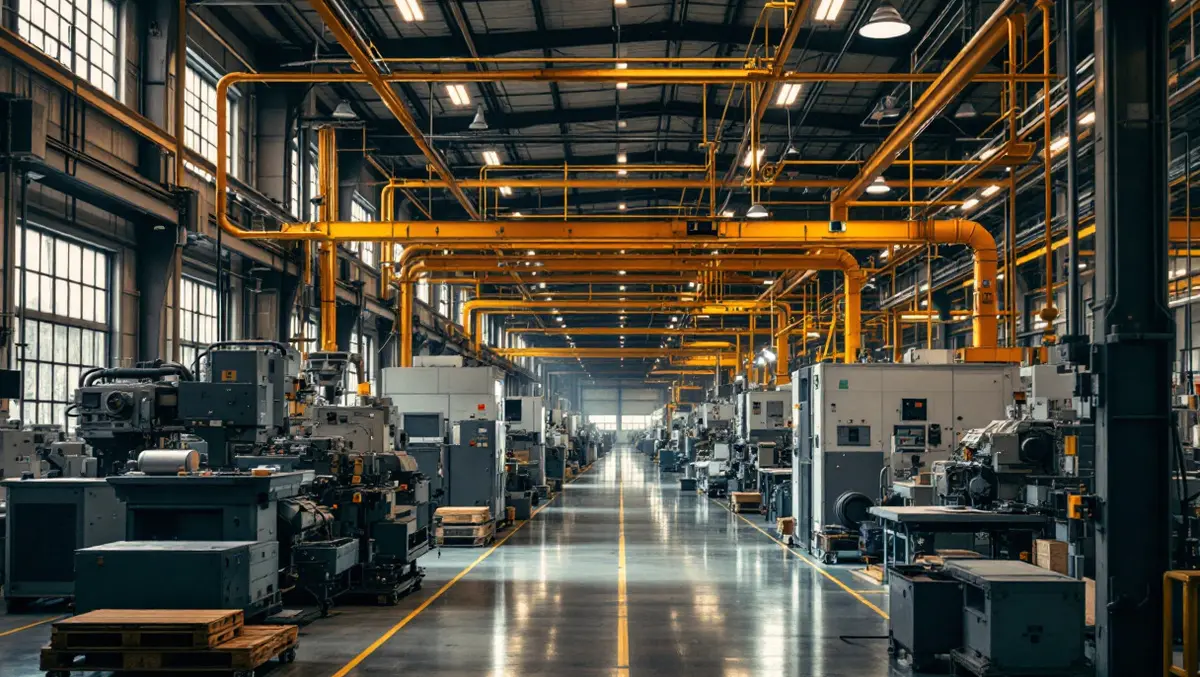
I've spent the past year watching the U.S. manufacturing story unfold in slow motion. When you zoom in on the data, what you see isn't a sudden collapse. It is a grinding normalization that reveals as much about our future economy as it does about our present slowdown.
After analyzing U.S. manufacturing activity, what I've found is that while headlines focus on tariffs or policy shocks, the slowdown is actually the product of deeper structural forces.
Manufacturing's share of U.S. GDP has declined from roughly 24% in the 1950s to around 10% today. But the thing is, output itself hasn't collapsed. In fact, absolute output is higher today than it was decades ago. The story is less about disappearance and more about economic evolution.
The 26-Month Contraction
From November 2022 to December 2024, U.S. manufacturing endured 26 consecutive months of contraction, the longest such period in decades. The drivers weren't mysterious. They were textbook macroeconomics at work.
Post-pandemic, America experienced a once-in-a-generation surge in goods demand. Inventories ballooned, new orders spiked, and companies scaled production aggressively. But by 2022, the cycle reversed. Demand cooled. The Federal Reserve raised rates by 525 basis points between March 2022 and July 2023, chilling business investment. A strong dollar eroded export competitiveness. Layer on downturns in semiconductors and equipment, and contraction looked inevitable.
Even survey data diverged: In August 2025, ISM showed contraction at 48.7, while S&P Global's PMI read 53.0. Same economy, different lenses.
Tariffs, which spiked in 2024 and 2025 across sectors like EVs (100%), semiconductors (50%), and solar (50%), added pressure. But they weren't the primary driver of the slowdown. They simply compounded existing weaknesses. Overall, eight out of ten industries contracting in 2025 had significant tariff exposure, but the contraction began long before the policy environment shifted.
Normalization, Not Collapse
Of course, it's tempting to frame this as an industrial decline story. But when you compare 2025 manufacturing output to pre-pandemic baselines, you see a different pattern. By July 2025, output levels were hovering around 100.2 on the Fed's Industrial Production Index, nearly identical to 2019 levels. What felt like a downturn was actually a reversion to the mean after an unsustainable boom.
Manufacturing isn't dying. It's normalizing. This difference matters. A sector in collapse demands rescue. A sector in normalization demands adaptation.
Margin Pressure and Investment Decline
Despite tariff-induced cost pressures, corporate profit margins remain elevated at 13.1% of GDP - but this masks a dramatic reallocation of capital. While investment in physical structures contracted 8.9% in Q2 2025, AI-driven software investment surged an unprecedented 195% annualized - contributing as much to GDP growth as the entire consumer services sector despite representing just 4% of the economy. This isn't a collapse; it's evolution in real-time.
The pressure here isn't cyclical but structural. According to EY's analysis, the combination of tariff-related costs, policy uncertainty, and immigration restrictions are creating "increasingly visible constraints" that will push the economy toward "stall-speed dynamics" by year-end, with Q4 2025 growth projected at just 0.8% annually.
Manufacturing is being forced to evolve faster than ever. Protecting margins means embracing strategic reallocation toward high-return technologies.
Winners, Losers, and the Services Economy
Tariff-exposed industries like fabricated metals, machinery, transportation equipment, and electronics were hardest hit. More domestically anchored sectors such as food, beverages, and petroleum have proven more resilient.
But the bigger story is services. Today, services account for about 80% of U.S. GDP - adding a value of $21.02 trillion - and 85% of employment. Technology, finance, and healthcare are the new engines of growth. And this isn't unique to America. It's a pattern across all advanced economies. As productivity gains in manufacturing allow more output with fewer workers, employment shifts to services. And as incomes rise, so does demand for software, healthcare, and financial services.
This tells me that America hasn't abandoned manufacturing, but it has repositioned it. The U.S. still leads in advanced manufacturing, R&D-heavy production, and high-value exports. But the center of gravity has shifted.
What does this mean for CEOs, strategists, and policymakers?
First, don't mistake a cyclical contraction for structural decline. Manufacturing remains a critical pillar of the U.S. economy, even as its share of GDP shrinks. The challenge is more competitiveness than it is survival.
Second, margin defense will increasingly come from intelligent systems. Companies need to embed AI into forecasting, procurement, and production. Not as a shiny add-on, but as core infrastructure. That is how you manage volatility, optimize working capital, and anticipate shocks before they hit the balance sheet.
Third, leaders must reframe resilience. Tariffs and monetary policy are externalities. You can't control them. What you can control is how quickly your organization adapts, how you build flexible supply chains, how you scenario-plan, and how you align capital allocation with structural shifts.
Finally, recognize that manufacturing's story is now inseparable from services. Digital infrastructure, advanced analytics, and enterprise AI aren't side projects. They are the connective tissue that keeps industrial economies competitive in a services-led world.
The Strategic Takeaway
The U.S. manufacturing slowdown isn't a death spiral. It is a normalization, a return to a baseline shaped by decades of structural transformation. The question isn't whether manufacturing will matter. It is how it will matter in an economy where services drive growth and AI drives advantage.
For leaders, the call is clear: Don't wait for stability. Build systems that thrive in volatility. Embed intelligence where fragility exists. And see the slowdown not as a warning sign of decline, but as an invitation to reimagine how industry adapts in a services-led, AI-powered future.