

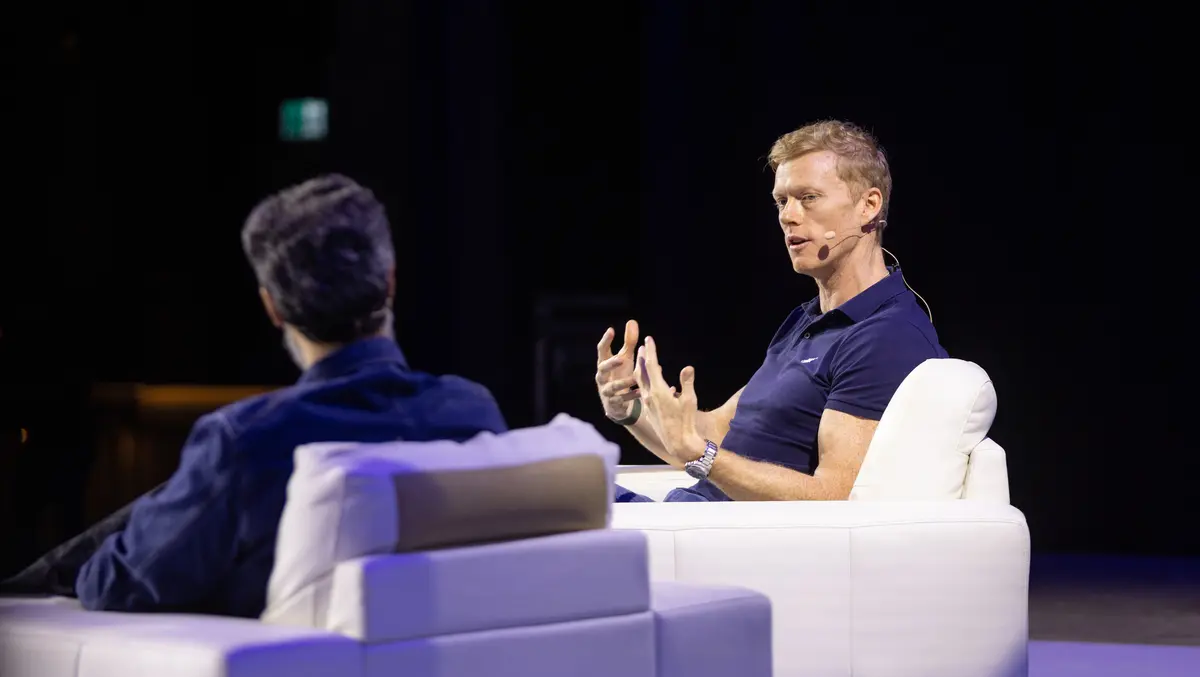
Lütke, MacDonald: AI will create jobs in T.O we can't foresee
Wed, 27th May 2026
It's no secret that Toronto is at the forefront of Canada's contribution to the current "industrial revolution," and the city's Tech Week Homecoming flagship session brought together a myriad of top tech executives to share their thoughts on the future of the country's industry.
Among the key ideas, Uber President and Chief Operating Officer Andrew MacDonald said the rideshare company is working with partners to bring driverless vehicles to Canada's largest city.
While he could not provide a concrete timeline, he elaborated on the ideal business model, in which the platform would act as a distribution service, engaging with partners within the app.
"Anyone who wants to put autonomous vehicles on our network, whether you're an OEM or you're an L4 software provider, whether you're fleet that owns the assets, whether your finances underwrites the assets - you put those vehicles on our network, you'll get very high utilisation ... So we're actively trying to encourage partners to bring their tech here."
Waabi, a Toronto-based company working on autonomous trucking and passenger vehicles, was mentioned as one of the companies Uber is working with on future demo plans. The self-driving car company, headed by CEO Raquel Urtasun, made headlines in January after reports that it had raised over USD $1 billion in funding.
MacDonald added that while Uber is eager to launch driverless cars in Ontario's capital, the federal government needs to develop frameworks to enable driverless vehicles to hit the streets.
Uber, which launched in Toronto in 2012 as its ninth city worldwide, was one of the first low-cost ride-share options.
"Toronto was the first international market to really battle for ride-sharing regulations ... [It] was one of the first sort of international battlegrounds for both the political and legal discussions that needed to happen," said MacDonald.
While some groups, including Toronto Mayor Olivia Chow, have warned that introducing driverless cars could result in job loss, MacDonald, a self-proclaimed traditionalist, argued that AI will ultimately spur economic growth well above baseline projections, generating entirely new categories of employment that are impossible to anticipate today while also creating induced demand for labour across a rapidly expanding economy.
"I can't specifically tell you what the 10.5 million people who earn money on Uber today are going to be doing in 15 years. I think for some period of time there will be more demands for gig economy workers. But we believe that hybrid - sort of a mix of humans and robots in our network - is going to be the solution for a number of years."
Shopify Co-founder Tobias Lütke has also weighed in on the job displacement debate.
"People think that there's not going to be enough jobs. The shape of companies is going to change absolutely, companies will be smaller, but there will be vastly more of them," he said. "I think the world's actually deeply impoverished in terms of how incredible the products are and what we can get by the fact that there's only very few companies that could actually pay or create environments for having excellent engineering. Now everyone has a seven out of 10 engineer on their phone right now for $200 a month"
Lütke is famous for his "Prove AI Can't Do It" Rule at Shopify. That being said, his messaging at Homecoming supported smaller companies, but never to the absolute bare bones.
"Is it possible to build the billion dollar one person company? Yes, it is possible. But why not spend some of that money to have someone else around? It's just like so irrelevant. So much of these stories are like you spend so much time to think if he could, but no one stops to think if he should," he added.
"The best thing you can do is do hard things that other people deem valuable, surrounded by friends. That's the kind of perfect configuration for life and plan growth. I think the point sort of directionally stands that there can be $1 billion five people companies."
He added that humans have historically found new jobs and new ways of earning a living. As an example, Lütke pointed to Formula One racing - an entire industry that exists not because it serves any fundamental societal purpose, but simply because people enjoy watching cars go fast.
"One single team has like 1600 people working - 800 people in car, 800 people in the engine flying around the entire world, all because we just decided to have a rule book. We are very good at coming up with jobs. There's going to be no shortage of people coming out to fix this. And I think we should do more of this. We should invent more things."