

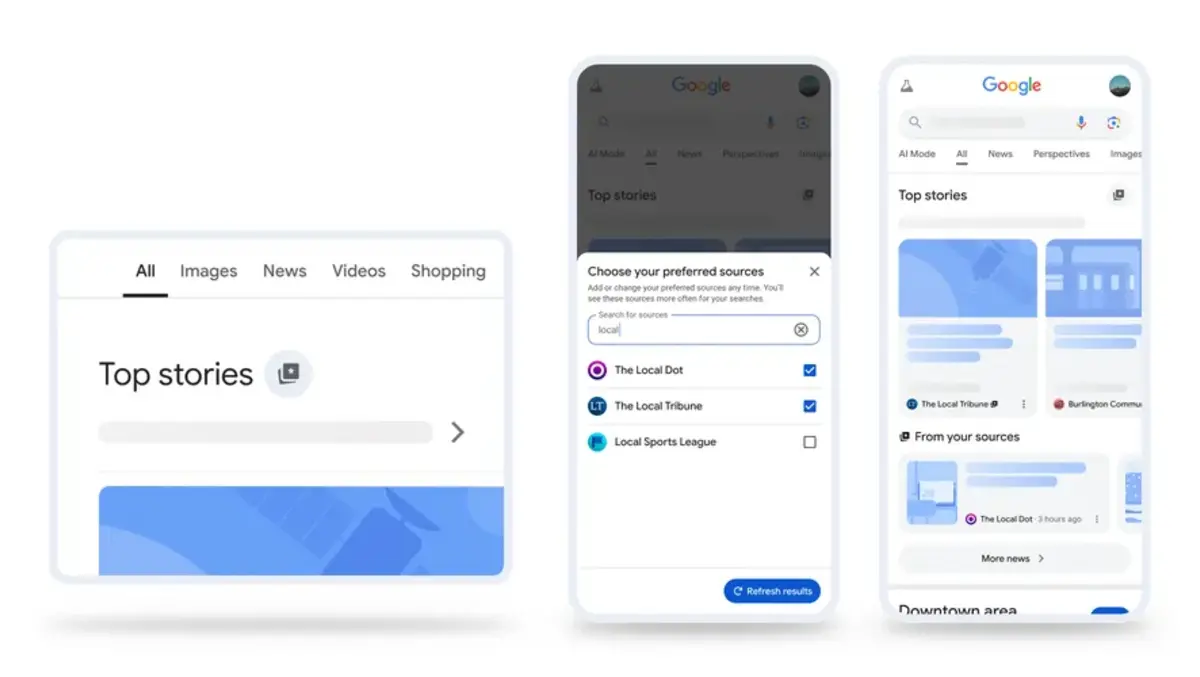

Google has expanded its Preferred Sources feature in Top Stories on Search, making it available for all English-language users worldwide, including in Canada, with support for more languages planned next year.
The feature launched in the United States earlier this year. It now forms part of a broader set of search and AI changes that Google says are designed to connect users with publishers and other online creators.
Personalised news lists
Preferred Sources allows people to customise the Top Stories carousel in Google Search. Users can mark specific outlets and websites as preferred and then see more links from those sources within Top Stories.
Google said people have selected nearly 90,000 unique preferred sources so far. These range from local blogs to international news brands.
The company said it had seen higher engagement with sites that users mark as preferred. When someone picks a preferred source, they click through to that site twice as much on average.
Users can access the feature through a star icon that appears next to Top Stories. They can choose as many outlets as they want and can adjust their list over time.
Google has published guidance for publishers and site owners who want their audiences to select them as preferred sources. Some news organisations have already asked readers to use the feature.
Publisher relationships
The rollout comes as Google faces scrutiny from governments and regulators over its relationships with news providers. Authorities in markets such as Canada, Australia, and the European Union have pushed the company to change how it works with publishers and how it shares advertising revenue.
Preferred Sources does not change the underlying ranking systems in Search. It adds a layer of personal preference on top of existing Top Stories results.
People who do not use the feature will continue to see Top Stories based on Google's regular ranking signals. These signals include relevance, quality, and freshness.
Google said early use of Preferred Sources suggested a broad spread of selected outlets, rather than concentration on a small set of large publishers. The company said this pattern included smaller and niche sites.
AI search changes
Alongside the Preferred Sources expansion, Google is making several updates to the way links appear within its AI-driven search experiences. These changes affect AI Mode in Search and the Gemini app.
Google is increasing the number of inline links that appear in AI Mode responses. It is also changing the design of those links.
The company said it will add short contextual introductions that sit next to embedded links. These short statements describe why a link might be useful to visit.
Google said this should make it clearer how AI-generated summaries relate to the underlying web pages. It said it also expects the change to provide more visibility for publishers' content inside AI responses.
The company is also introducing a feature that highlights content from news subscriptions within Gemini. This feature will surface links from outlets that a user already pays for or has registered with.
Google will prioritise links from subscribed publications inside Gemini. It will display these in a separate carousel to make them easier to spot.
The company plans to introduce the subscription highlighting feature in the Gemini app first. It then intends to extend it to AI Overviews and AI Mode in Search.
Competition for attention
The moves reflect growing competition around where users start their news journeys. Social platforms, messaging apps and dedicated news aggregators compete with search engines for reader attention.
News organisations have raised concerns that AI-generated answers in search products could reduce direct traffic to their websites. They have argued that this may weaken advertising and subscription revenue.
Google has said its AI search features still send significant traffic to publishers. It has pointed to outbound links and new presentation formats as evidence.
Publishers are now experimenting with prompts and calls to action that encourage readers to select them as Preferred Sources. These appear within articles, newsletters, and on social media.
"People have selected a wide range of preferred sources - nearly 90,000 unique sources, from local blogs to global news outlets. When someone picks a preferred source, they click to that site twice as much on average," said a Google spokesperson.
Google plans to extend Preferred Sources beyond English into all supported languages early next year.