

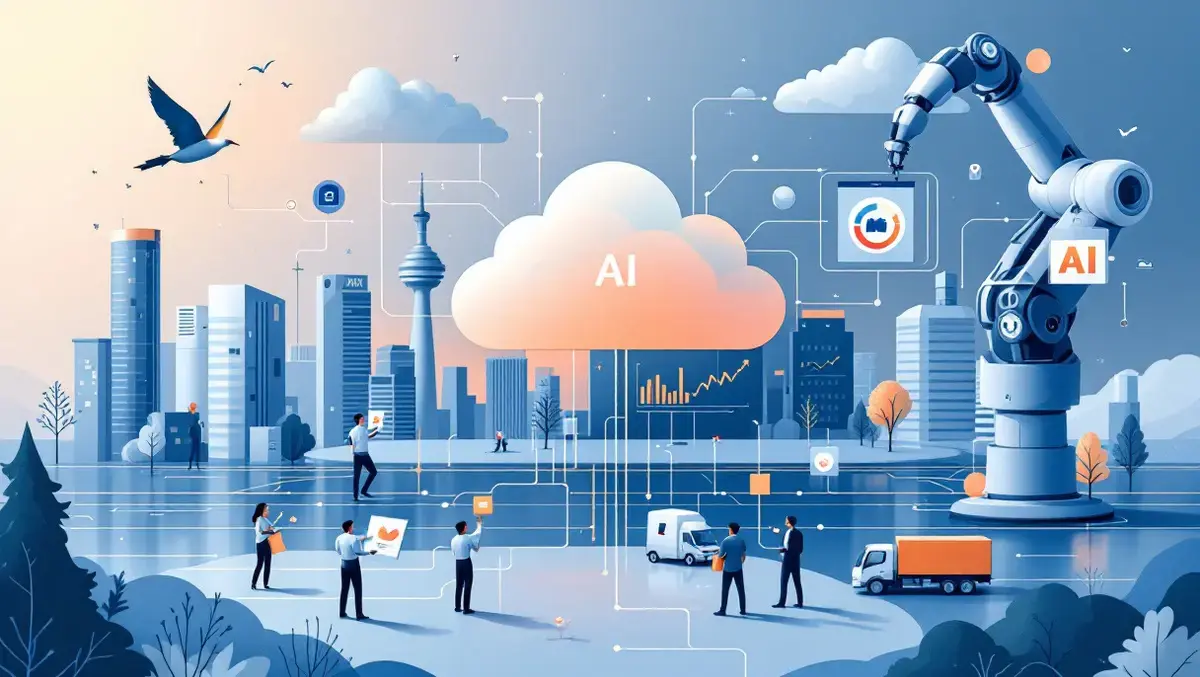
AWS Canada spotlights nine AI pioneers across sectors
Sun, 28th Jun 2026
AWS Canada has highlighted nine Canadian organisations using artificial intelligence in healthcare, wildfire response and drug discovery, among other fields. The group includes companies and research efforts from Montreal, Toronto, Calgary, Vancouver and Trois-Rivières.
The organisations are AlayaCare, Haply Robotics, KOHO, Logan, SMART Technologies, Variational AI, Voxelis AI, Waabi and Waste Robotics. Their work ranges from administrative tools for home care and educational software to robotics, environmental analysis and autonomous transport.
The selection comes as AI adoption spreads quickly across Canadian business. A recent AWS Canada study found 65% of Canadian businesses use the technology, mainly for workflow tasks or content generation rather than more specialised applications.
Healthcare and education
Montreal-based AlayaCare uses AI software for home care agencies. Its tools summarise patient histories and automate tasks such as scheduling, visit verification and care-plan generation.
"We're oriented around better patient care in the home," said Adrian Schauer, founder and CEO of AlayaCare. "Technology is just the enabler."
In Calgary, SMART Technologies has built an AI-based platform called Lumio to support lesson planning and more personalised learning. Teachers using the system have seen productivity rise by up to 75%, while schools in remote locations gain wider access to teaching support.
"Teaching is one of the most important jobs in the world," said Nicholas Svensson, chief executive officer of SMART Technologies. "The most important thing for a teacher is to teach, not to get caught up in all the technology. It's a big challenge, but it's one that we're here to serve."
Robotics and Finance
Another Montreal company, Haply Robotics, is developing force-feedback controllers and AI models designed to help robots respond to touch. The business traces its origins to neurosurgery simulation research at the National Research Council of Canada.
"If humans learn by doing and manipulating objects," said Felix Désourdy, co-founder of Haply Robotics, "why couldn't robots do the same? We're writing a new chapter out of Montreal for physical AI, one where the sense of touch is opening up infinite possibilities."
Toronto-based KOHO is applying generative AI to consumer finance, focusing on Canadians with limited access to traditional credit. It evaluates broader signs of financial responsibility to help users improve credit scores.
"We're building KOHO for the average Canadian," said Daniel Eberhard, founder and CEO of KOHO. "That's how you go from directly impacting a few million people to indirectly impacting the entire country."
Climate and science
Environmental applications feature strongly among the nine organisations. Logan, developed by a team at the University of Toronto's Donnelly Centre, is an open-source DNA search engine that indexes public genetic data and is being used to identify plastic-degrading enzymes.
According to the project's founder, the system has searched more than 39 million DNA and RNA sequencing datasets and uncovered more than a billion enzyme variants in 10 hours.
"We think of microplastics as a very synthetic problem, but the irony is that the solution might already be in nature," said Artem Babaian, assistant professor of molecular genetics at the University of Toronto's Donnelly Centre. "Anywhere life has found a way to do interesting chemistry, we now have a way to find it and help transform our world for the better."
Vancouver-based Voxelis AI is focused on wildfire suppression. Its VoxVision device is fitted to helicopters and uses machine learning to analyse thermal imagery and environmental data for pilots, ground crews and incident commanders.
"VoxVision is like strapping a robot to an aircraft," said Colin O'Neill, founder of Voxelis AI. "We want to turn every aircraft doing wildfire suppression into an intelligent node that helps people on the ground make better decisions to put fires out faster."
Waste Robotics, based in Trois-Rivières, develops AI-guided sorting robots for waste and recycling facilities. Its systems recognise objects with 98% to 99% precision as operators look for ways to process higher volumes of mixed waste.
"We are pushing the limits of what's possible in terms of circularity with AI and robotics," said Eric Camirand, co-founder and CEO of Waste Robotics. "Today, we have all the tools and technology to accomplish true circularity of the products we consume."
Drug discovery and transport
Vancouver-based Variational AI is using generative AI in drug discovery. Its Enki platform designs small-molecule drug candidates up to 100 times more efficiently than traditional methods.
"Canada has the seventh most pre-clinical programs in the world," said Handol Kim, co-founder of Variational AI. "And yet we have no homegrown non-generic pharma companies in the top 100. Wouldn't it be great if we did? AI is how we get there so we can achieve health sovereignty."
Waabi, also based in Toronto, is developing autonomous driving systems through simulation-based training. Its Waabi World platform tests millions of driving scenarios overnight and supports both long-haul trucks and robotaxis through a shared AI model.
Its work has already led to a partnership with Volvo on autonomous trucks and an agreement with Uber to deploy 25,000 robotaxis. Waabi has also raised more than USD $1 billion.
"We can train and test under all conditions, so that we can deploy safely. We are building an incredible generational company here in Canada that is going to change the world," said Raquel Urtasun.