



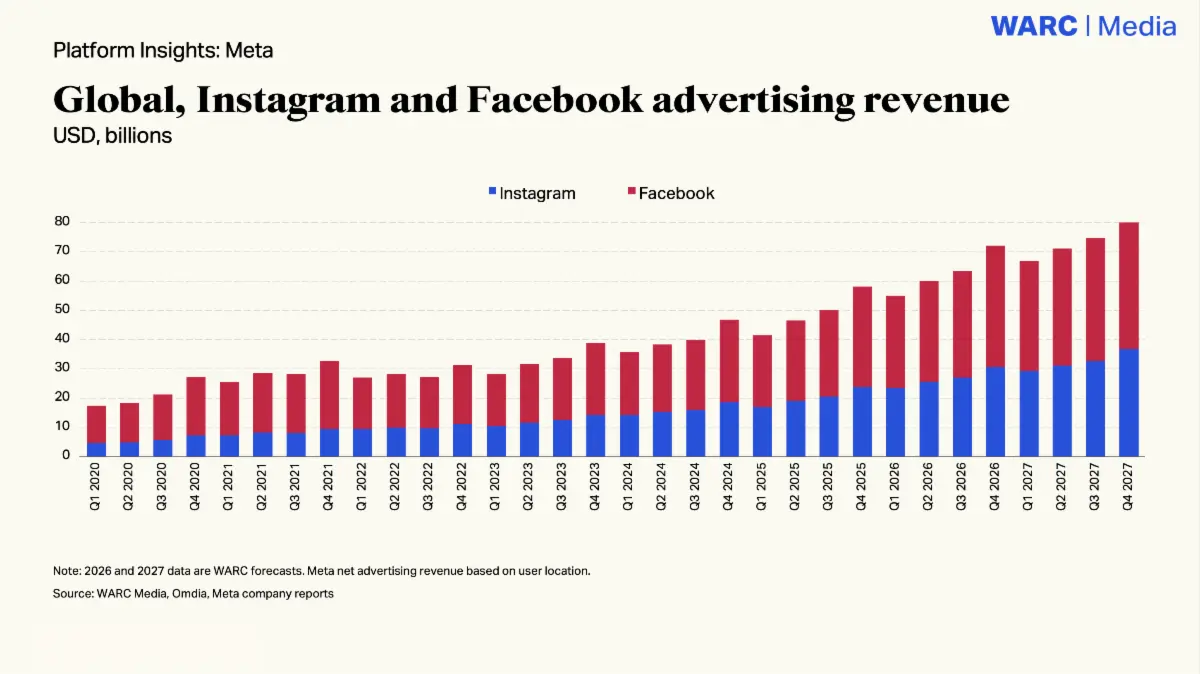
Meta is on course to generate USD $240 billion in advertising revenue in 2026, according to WARC, pointing to another year of growth ahead of the wider social media market.
WARC forecasts that Meta's advertising business grew 22% to USD $196 billion in 2025 and will rise a further 22.3% this year, before slowing to 12.1% growth in 2027. The figures highlight how central advertising remains to Meta's business as it increases spending on artificial intelligence.
Facebook is still expected to be Meta's larger advertising platform this year, accounting for 60% of ad revenue, with Instagram making up the remaining 40%. That split comes even as marketers show a stronger appetite to increase spending on Instagram than on Facebook.
WARC's annual marketer survey found that 55% of global marketers plan to raise investment in Instagram this year, compared with 25% for Facebook. The US remains Meta's largest market for ad investment, with a 42.2% share on Facebook and 40.5% on Instagram, followed by the UK and Australia.
Investor concern
According to the report, Meta's increased investment in AI is being funded mainly by advertising income. In its latest earnings call, the company outlined annual capital expenditure of between USD $125 billion and USD $145 billion on AI. WARC said the move has unsettled some investors because Meta has fewer alternative revenue streams than rivals such as Alphabet and Amazon.
Those concerns have been sharpened by signs that audience growth is no longer as straightforward as it once was. More than 3.5 billion people around the world use at least one of Meta's apps every day, but restrictions in Russia and Iran led to its first quarter-on-quarter decline in total daily active users earlier this year.
Alex Brownsell, Head of Content at WARC Media and co-author of the report, said: "Meta's flywheel is spinning faster than ever. The company's AI-driven automation is transforming how brands connect with audiences, driving rapid growth in advertising spend with Facebook and Instagram. This is enabling further record-breaking levels of investment in AI innovation.
"Yet investors appear concerned that the flywheel is at risk of spinning out of control, in light of plateauing user growth and mounting pressure to better monetise existing audiences. In this report, we explore the latest evidence-based insights to better understand Meta's ad model and consider what might come next."
Audience trends
Facebook's scale means its user base broadly mirrors the age profile of the wider internet population, while Instagram attracts a younger audience. WARC, citing Ipsos analysis, said Millennials and Gen X account for more than 70% of wealthy global users on Facebook and Instagram.
Regional patterns are less aligned with revenue generation. Latin America and Sub-Saharan Africa show the strongest engagement among high-net-worth users on Facebook and Instagram, but revenue per user remains far below North America and Europe.
Meta is trying to improve returns in those markets through expansion moves such as introducing Threads advertising in Brazil. The market is seen as an important test of whether Meta can lift monetisation outside its most lucrative regions.
Short-form video is taking a larger share of attention across Meta's apps. Reels now accounts for 45% of all engagement on Instagram and 29% on Facebook, while time spent watching video content on Facebook rose 8% quarter on quarter worldwide, the report said.
Campaign results
AI tools are also changing campaign performance on Meta's platforms. WARC cited Meta data showing a 24% increase in incremental conversions from a model rollout in the fourth quarter of 2025, driven by improved attribution.
Separate analysis by Fospha found that cost per purchase improved by 4.5% year on year. Brands using Advantage+ recorded a 41% higher blended return on ad spend and a 17% lower new customer acquisition cost than those running manual campaigns, according to WARC.
Creator-led advertising is also becoming more important. The report found that 71% of consumers make purchases within days of seeing creator content across Meta's apps through Partnership Ads.
Kantar data cited in the report showed that the average campaign allocates 4% of budget to Instagram and 5% to Facebook, yet both platforms produce relatively stronger shares of brand awareness, association and motivation to buy. Global marketers ranked Instagram as the second most preferred media brand after YouTube, while more than 40% said it is among the top four platforms for attention.
The report added that consumers see advertising on both Instagram and Facebook as "fun" and "entertaining".